


About the Conference
Build on a strong foundation of interdisciplinary collaboration, this conference brings together scientists, conservationists, policymakers, educators, community leaders, and innovators. It is envisioned to bridge the gap between research, practice, and policy; the joint NMK & AKE biennial conference is becoming a leading forum for discussing the role of biodiversity in sustainable development. Leveraging on our 1st joint International conference the 2026 conference will provide a platform to:
1. Showcase scientific discoveries in biodiversity and heritage
2. Promote nature-based solutions to pressing global challenges
3. Highlight community-driven conservation success stories
4. Influence policy and inspire action at all levels
2026 Theme Overview
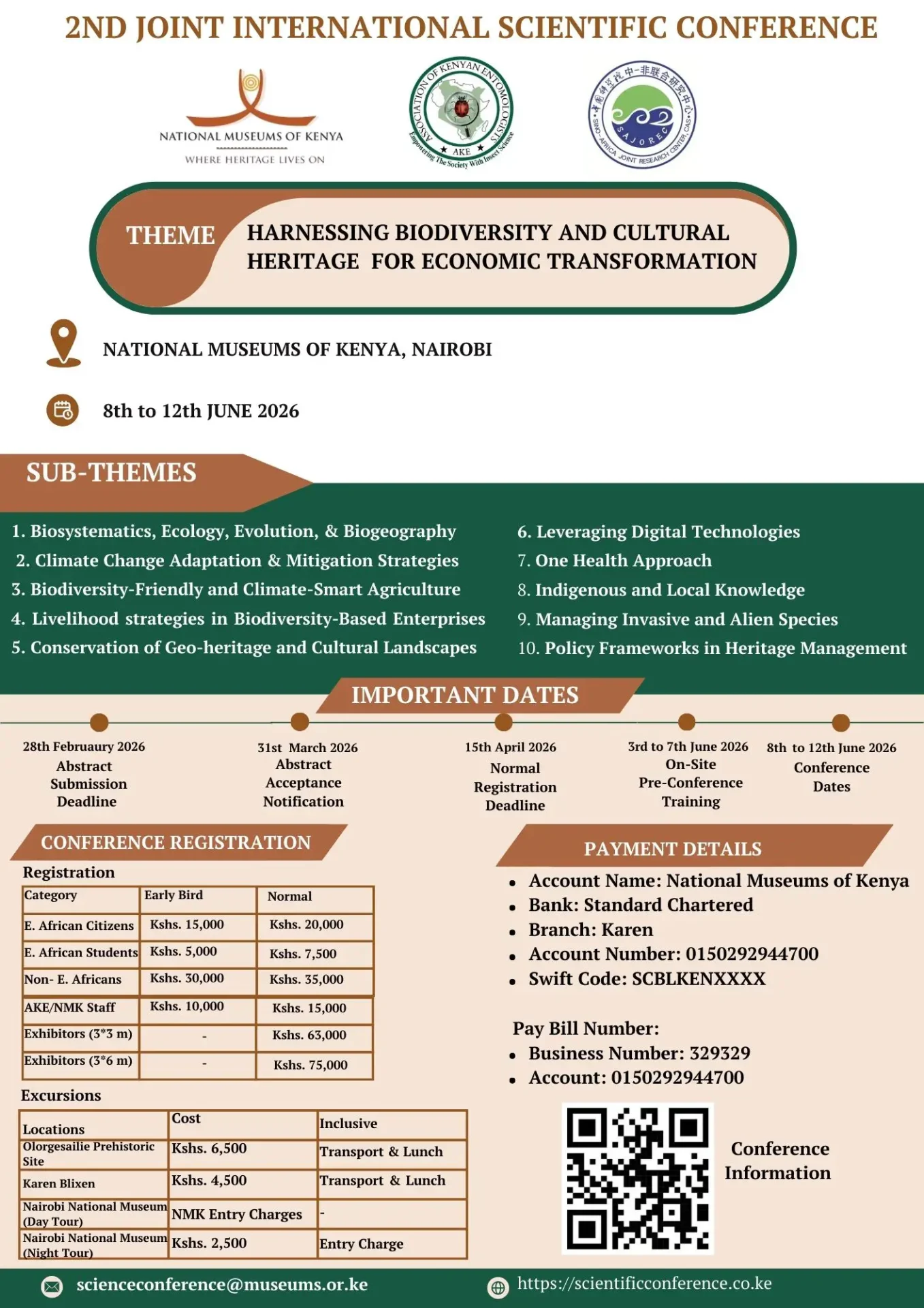
Harnessing Biodiversity for Economic Transformation and Heritage Conservation
This conference theme underscores the strategic role of biodiversity and heritage in driving inclusive, sustainable economic growth. From rural livelihoods to urban planning, biodiversity underpins development while safeguarding our cultural identity and resilience to climate change.
Conference Goals
Our key objectives are to:
Promote dialogue across disciplines and sectors
Demonstrate the economic potential of biodiversity and heritage
Uplift indigenous knowledge and local solutions
Inspire innovation in biodiversity management
Strengthen evidence-based policy development
Conference Sub-themes Explained
Explore our ten rich sub-themes that form the story lines of this year’s conference:
- 1. Bio systematics, Ecology, Evolution, and Bio geography
- At the core of biodiversity conservation is a deep understanding of what species exist, how they are related, where they are found, and how they interact with each other and their environments. This sub-theme focuses on the foundational biological sciences that inform all other aspects of conservation, restoration, and sustainable use. The sub theme highlights the importance of species classification, evolutionary biology, ecological interactions, and the spatial distribution of biodiversity as foundational tools for conservation planning and monitoring.
- 2. Climate Change Adaptation and Mitigation Strategies
- Climate change is one of the most urgent challenges facing the world today, posing serious threats to ecosystems, livelihoods, health, and heritage. Yet, nature itself offers some of the most cost-effective and affordable solutions. By working with nature not against it we can reduce emissions, protect biodiversity, and build resilience for both ecosystems and people. This subtheme explores innovative and practical ways to adapt to and mitigate the impacts of climate change, with a focus on ecosystem-based approaches that are sustainable, inclusive, and grounded in local realities.
- 3. Biodiversity-Friendly and Climate-Smart Agricultural Practices
- Agriculture plays a critical role in our economy yet also contributes to both biodiversity loss and climate change. Transitioning to biodiversity-friendly agriculture is essential not only for protecting nature but also for ensuring long-term food security, rural livelihoods, and climate resilience. This subtheme focuses on transforming agricultural systems to become more sustainable, resilient, and inclusive, while enhancing food security and conserving ecosystem. It highlights success stories, innovations, and policy tools that empower communities to farm in harmony with the environment, securing both people and the planet.
- 4. Livelihood Strategies in Biodiversity-Based Enterprises
- Biodiversity is not only essential for ecosystem health. It is also a powerful engine for local economies. Sustainable use of biodiversity can be a win-win for conservation and development. Biodiversity-based enterprises provide meaningful income, especially in rural areas, while incentivizing the protection of ecosystems. This subtheme explores how individuals and communities are transforming natural capital into economic opportunities by building sustainable, conservation-friendly enterprises that both protect nature and improve livelihoods. The subtheme invites participants to share models, experiences, and innovations that transform natural heritage into sustainable prosperity.
- 5.Conservation of Geo-heritage and Cultural Landscapes
- Geo-heritage and cultural landscapes are not just remnants of the past they are living legacies that shape community identity, ecological integrity, and national pride. While, modern development offers opportunities for economic growth and social transformation, it also poses threats to irreplaceable heritage sites, natural wonders, and cultural landscapes. When development is harmonized with heritage conservation, we build resilient, inclusive, and culturally rich societies. This subtheme invites interdisciplinary approaches and real-world examples that show how to protect what matters most while building for the future. The subtheme explores how infrastructure, urbanization, and land use can be designed and managed to respect and protect geo-heritage and culturally significant places, ensuring that progress enhances rather than erodes our collective identity
- 6. Leveraging Digital Technologies
- In this digital age, technology is transforming how we understand, monitor, protect, and communicate about biodiversity. Digital technologies are revolutionizing conservation not by replacing people, but by amplifying their efforts. They enable faster, more accurate, and inclusive biodiversity management, bringing real-time insights into the hands of scientists, communities, and decision-makers. This subtheme explores the growing role of digital innovations in advancing conservation goals, enhancing data accessibility, empowering communities, and informing environmental decision-making. The subtheme invites contributions that showcase how technology is bridging gaps between data, people, and nature.
- 7. One Health Approach
- In an era marked by global health crises and environmental degradation, protecting nature is protecting life. The One Health approach offers a path forward where human well-being, animal health, and ecological integrity are treated not as separate issues, but as interconnected priorities. The health of humans, animals, and ecosystems is deeply interlinked. This subtheme focuses on the One Health concepts holistic framework that promotes cross-sector collaboration to tackle complex challenges at the interface of public health, veterinary science, environmental conservation, and sustainable development. It underscores the interconnectedness of human, animal, and environmental health and offers integrated solutions to shared challenges such as disease outbreaks and habitat loss.
- 8. Indigenous and Local Knowledge
- Biodiversity conservation is strongest when it respects and uplifts the wisdom of those who live closest to the land. Across generations, Indigenous Peoples and local communities have cultivated rich, place-based knowledge systems that guide the sustainable use, protection, and restoration of biodiversity. Indigenous and local knowledge not only enhances ecological resilience but also embodies a worldview that honors balance, reciprocity, and sustainability. This subtheme highlights the value of indigenous and local knowledge (ILK) in conservation and calls for its equitable recognition, inclusion, and protection within mainstream environmental frameworks. Acknowledging the role of traditional knowledge systems in biodiversity stewardship, the subtheme invites participants to present case studies, and frameworks that promote genuine collaboration between traditional knowledge holders and formal science and policy arenas.
- 9. Managing Invasive and Alien Species
- Invasive and alien species are among the top drivers of biodiversity loss worldwide. They disrupt native ecosystems compromising on their integrity and resilience, thus threatening species survival, degrading habitats, and consequently affecting agriculture, fisheries, health, and tourism. By tackling them head-on Through research, collaborations, and practical action, we can come up with practical ways of protecting native ecosystems, support food systems, and safeguard cultural and natural heritage. This subtheme invites contributions that inspire innovative and scalable solutions for managing biological invasions in a changing world. This subtheme focuses on detecting, preventing, controlling, and restoring areas habitats impacted by invasive species.
- 10. Policy Frameworks in Heritage Management
- Effective policies are the scaffolding that holds conservation efforts together. Without enabling legal environments, even the best scientific and community initiatives may falter. Heritage and biodiversity conservation depend not only on science and community effort but also on robust, inclusive, and forward-looking legal and policy frameworks. This subtheme focuses on examining how national, regional, and global policies influence the stewardship of natural and cultural heritage, and how reforms can enhance their impact offering insights on legal reforms, community rights, and governance mechanisms that support sustainable heritage and biodiversity management. This subtheme also invites policymakers, legal scholars, practitioners, and advocates to contribute policy solutions that safeguard our heritage while enabling sustainable development for present and future generations.
About National Museums of Kenya
The National Museums of Kenya (NMK) is a state corporation established under the Museums and Heritage Act of 2006. As a multidisciplinary institution, NMK is mandated to collect, preserve, study, document, and present Kenya’s cultural and natural heritage. These efforts are aimed at fostering knowledge, appreciation, and respect for heritage, while promoting its sustainable use for the benefit of Kenya, the region, and the global community now and for future generations.
In line with its commitment to biodiversity conservation, cultural preservation, and public engagement, NMK manages numerous regional museums, heritage sites, and monuments of national and international significance. These are complemented by priceless collections that reflect Kenya’s dynamic living heritage.
As part of its continued efforts to address emerging societal and environmental challenges, NMK is proud to host the 2nd Joint International Scientific Conference, scheduled for 8th–12th June 2026 in Nairobi. Under the theme “Harnessing Biodiversity and Cultural Heritage for Economic Transformation”, this conference will bring together scholars, practitioners, and stakeholders from diverse fields to explore innovative approaches to conservation, sustainability, and development.
Through this vibrant scientific platform, NMK reaffirms its unique role in shaping national discourse and contributing to regional and global development.
Website: National Museums of Kenya
About Association of Kenyan Entomologists
The Association of Kenyan Entomologists (AKE) is a professional society registered in the Republic of Kenya under The Societies Rules, 1968, rule no. 4. It was registered on Wed 21 February 2024 following the dormancy of the Entomological Society of Kenya registered in 1993.
The Society has a current membership of 193 members, with about 50% holding PhDs, including many eminent entomologists in Kenya. Membership also includes senior entomologists actively working in the country.
The Society has the following objectives:
- To improve entomological science and its diffusion
- To provide a forum for discussion and a medium for dissemination of knowledge among members and the public
- To disseminate knowledge and publish research through society publications
- To provide expert advisory services wherever needed
The Society welcomes eligible candidates to join and contribute to entomological advancement.
Personal benefits of joining AKE include but are not limited to:
- Peer membership with professionals in entomology
- Mentorship opportunities
- Influence in scientific discourse of interest
- Access to professional contacts
- Justification of your professional standing
- Leadership opportunities within the society
- Professional recommendations
- Publishing in the society newsletter
- Connections with key authorities
- Training opportunities via linkages
About Sino-Africa Joint Research Centre (SAJOREC)
Who We Are
The Sino-Africa Joint Research Centre (SAJOREC) is a world-class research institution established through a collaboration between the Chinese Academy of Sciences (CAS) and Jomo Kenyatta University of Agriculture and Technology (JKUAT). The Centre serves as a hub for cutting-edge scientific research, innovation, and capacity building in Africa, focusing on biodiversity conservation, sustainable agriculture, environmental protection, and natural resource management.
Since its establishment, SAJOREC has been at the forefront of scientific collaboration between China and Africa, promoting international partnerships that drive impactful research and technological advancements.
Our Vision
To be a global leader in biodiversity conservation, scientific research, and technological innovation for the sustainable development of Africa.
Our Mission
To conduct world-class research, innovation, and training in biodiversity conservation, sustainable agriculture, and environmental protection, fostering the growth of Africa’s scientific capacity.
What We Do
- Biodiversity Conservation & Ecological Research: Study, protection, and restoration of Africa’s biodiversity, including wildlife conservation, ecological sustainability, and climate change impact research.
- Agricultural Innovation & Food Security: Research on sustainable farming techniques, soil health, pest and disease control, and drought-resistant, high-yield crop varieties.
- Environmental Protection & Climate Studies: Solutions for sustainable land use planning, water resource management, renewable energy, and climate resilience strategies.
- Scientific Research Laboratories: State-of-the-art facilities supporting molecular biology, genetics, soil and water analysis, biomedical studies, and disease control research.
- Botanical Garden & Medicinal Plant Research: Conservation and study of medicinal plants and indigenous flora, integrating traditional knowledge with modern science.
- Academic Training & Capacity Building: Internships, mentorships, scholarships, research grants, and knowledge exchange programs for emerging scientists.
- International Collaboration & Partnerships: Joint research projects, technology transfer, and global knowledge-sharing initiatives with universities and NGOs.
Why SAJOREC Matters
SAJOREC bridges scientific discovery and practical application, supporting communities through innovation, advanced research facilities, and a strong commitment to education—shaping Africa’s future one discovery at a time.
